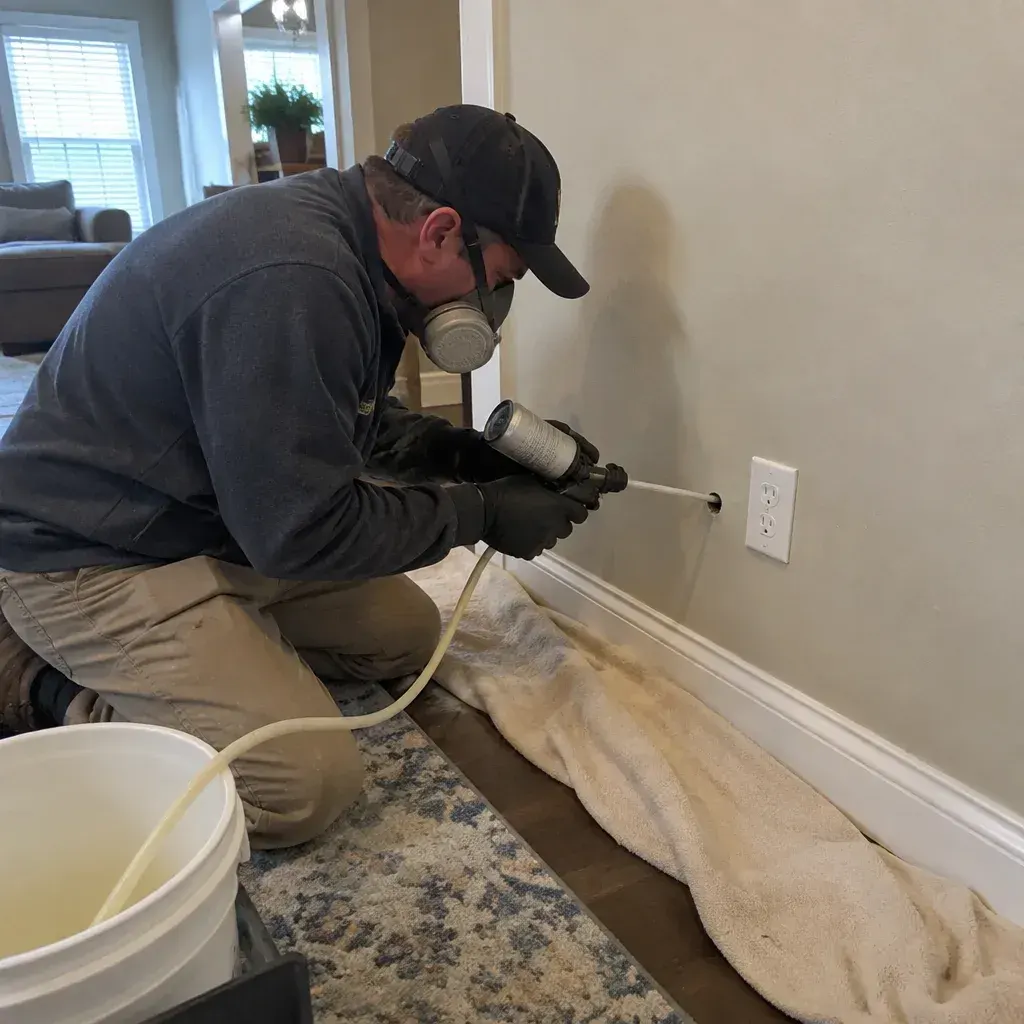
When Foam Can Reach Termites in Frederick
In Frederick, termite foam treats a limited space; access, barriers, product directions, and occupant precautions determine whether it fits.
Termiticide foam can treat termite activity when an inspection identifies a reachable wall void, the access point connects to that space, and the product label allows the use. Barriers may limit spread, so foam placement does not show that other hidden areas were treated.
How Foam Moves Through a Void
After you find a soft patch or damaged trim in a Frederick home, the wall may hide the route termites use. Termite foam is a pesticide formulation that expands after application. It can coat surfaces inside a reachable cavity, where termites may travel. A ranch near Urbana Regional Library and a townhouse elsewhere can have different wall layouts. The address does not show whether a void holds activity. A professional needs evidence of a target and a product approved for that use.
Foam injection sends the material through an access opening toward a chosen cavity. As it expands, it can spread over portions of nearby surfaces. The foam later settles, leaving termiticide where it made contact. In Frederick, a narrow opening may provide access without exposing a broad section of wall. But the nozzle reaches only spaces connected to that opening. The formulation cannot be assumed to pass through every gap, around every stud, or into every concealed route.
A wall void treatment may fit when evidence points to a specific enclosed space and the applicator can reach it. Termites may use galleries within wood, so activity could sit beyond the open cavity. Foam can be considered for a reachable target, subject to the product’s permitted use. In a Frederick home near Urbana Community Park, for example, the building’s own signs matter more than the landmark. A suspected route alone does not establish that foam will reach the insects.
Reaching Galleries Through an Opening
The useful question is where termites are moving, not where a wall sounds hollow. In Frederick, an inspection can connect visible evidence with an accessible cavity. The professional may examine damaged material, tubes, or other signs and note which areas remain hidden. These observations help distinguish a plausible foam target from a guess. A written treatment scope can identify the intended location and method. It should also say what evidence supports treating that particular void.
The access point must line up with the space that needs treatment. Framing, insulation, fire stops, or separate wall sections can block movement. Foam may fill a nearby pocket while leaving a connected gallery untouched. In Frederick homes, construction differs from one property to another, including houses near Main Street. An opening in one room does not prove access to the same cavity elsewhere. The professional should explain what the injection point can reach and what remains beyond it.
A product label sets the allowed sites, application method, and precautions for that formulation. Those directions control whether foam belongs in a particular wall or other enclosed space. In Frederick, site conditions also matter: an opening near wiring or a living area may raise practical concerns. Some foams expand after application, so the space inside a cavity can affect where the material goes. Do not infer safe use from the word foam or from another product’s instructions.
Barriers That Restrict Foam Travel
In Frederick, cavities vary by house. Activity in one part of a cavity does not show that the rest is accessible. Termite foam expands after injection, moving through connected gaps and into some galleries. Framing, insulation, or a closed break can block that movement. A wall void treatment may fit when inspection locates activity in an accessible cavity and the product label permits that use. A home near Urbana High School may have a different layout. Foam injection cannot show whether material reached every part of a void. Have a qualified professional assess the opening and label directions, including any access restrictions.
A proposed injection may require drilling through drywall, trim, or another finish. That opening can need patching after application, and the scope should say who handles it. In Frederick, ask where the hole will go and whether access could disturb wiring, insulation, or stored belongings. These details do not decide whether foam can control termites, but they affect safe access and cleanup. A professional should describe the planned opening before applying product and follow the label’s handling directions.
Product Directions and Occupant Safety
Foam placement cannot show whether concealed wood is structurally sound. Termites may damage wood inside a wall while the visible finish still looks intact. In a Frederick property, ask whether the inspection found visible damage and whether hidden areas need separate evaluation. Treatment and repair answer different questions. The proposed foam location should be recorded, along with any limits on what was inspected. That record helps you understand which areas were addressed and which still need attention.
Before agreeing to a wall void treatment, ask the professional to link three details: the observed evidence, the reachable space, and the product’s allowed use. In Frederick, the answer should make clear why foam fits that cavity and what it cannot cover. If the target is uncertain or directions do not permit the application, pause for an explanation. Review the label and written scope together. The decision depends on the building and inspection findings, not the foam’s expansion alone.
Before Considering Foam Treatment
- Ask what inspection evidence points to the specific cavity proposed for foam treatment, rather than relying on a hollow sound or a suspected route.
- Confirm the injection opening reaches the target space; framing, insulation, and separate compartments may block foam from moving farther.
- Get the product’s people and pet precautions, access location, and written explanation of the spaces the application will leave untreated.
- Check that the planned opening leads into the affected cavity; foam follows available space, so a disconnected void gives the treatment nowhere to travel.
- Wall construction changes the route: framing, insulation, or sealed sections may interrupt movement. A blocked route can leave part of the wall void beyond the foam's reach.
- Before foam injection, match the site and use to product directions, then confirm which rooms people and pets must avoid until return conditions are met.
Termite Control Questions
Can termite foam repair wood damaged inside a wall?
Treating a cavity does not restore wood already damaged by termites. In Frederick, the professional should explain the evidence and access point before treating. Framing or insulation may block the route. Foam is a localized application, so it does not establish that other parts of the structure are covered.
When can my family return after foam injection?
Follow the product label and the applicator’s directions for keeping people and pets away. The required area and return conditions depend on the product and how it is used. Ask which spaces are restricted and what must be true before reentry. Do not rely on directions for a different termiticide. In Frederick, get the precautions for the product planned at your property before application begins.
Will foam reach termite activity beyond the injection point?
No. Foam reaches only the spaces connected to its injection point, and framing or other barriers can limit spread. Termites may also use concealed galleries beyond the treated cavity. In Frederick, ask the professional to identify the area the opening can reach and any spaces left outside that target. An application in one void does not confirm treatment of the whole building.
Check the Void and Occupant Precautions
Ask the pros we connect you with to identify the target void, product directions, and room restrictions before foam injection.
Call (301) 756-1392